
Robot lawn mowers are autonomous. Once you set them up, they automatically navigate your lawn and mow the space.
But the real question is, how do robot lawn mowers navigate?
The navigation accuracy, as well as the features and pricing, highly depend on the navigation technologies a robot lawn mower is equipped with. It defines the overall performance and capabilities.
Let's understand how robot lawn mowers navigate. We will discuss the technologies they use along with their advantages and shortcomings. It will help you decide which navigation technology you should prefer.
How Do Wired Robot Mowers Navigate?
It's a bit of an old-school technology, but some robot mowers still rely on it.
It requires a perimeter wire that you need to run around the edges of your lawn. You have to bury the wire and create a loop or closed circuit. The wire is connected to the base station of the mower. It starts from there and loops back.
The base station is responsible for pushing a low-voltage AC current in the wire at a specific frequency. Because of this, a constant and directional electromagnetic field is created.
Robot mowers have an inductive coil sensor that can detect the electromagnetic field. Inside the loop, the mower senses positive polarity. Outside the loop, it senses negative polarity. That's how it knows which area it needs to mow.

Whenever it crosses the wire or goes over it, the sensor detects a change in polarity, and the computer issues a stop command to the mower. Then, it reverses, rotates to a random angle, and resumes mowing. That's why there is no fixed route. The mower moves in a straight line until it reaches its boundary wire or any obstacle.
When the battery is about to die, the mower moves to the boundary and returns to its base station by following the wire. However, some mowers use a guide wire, which runs through the middle of the lawn. It has a unique frequency to guide the mower when it needs to recharge.
How Do Wireless Robot Mowers Navigate?
Wireless robot mowers do not rely on perimeter wires. They rely on wireless technologies, one or multiple, to guide them through the lawn. They are preferred over wired mowers because they are much more efficient and easier to install.
Here are some common technologies used by wireless robot mowers.
RTK
RTK stands for Real-Time Kinematic. It addresses issues with standard GPS and helps mowers navigate with greater precision.
Mobile phones also have GPS, and the same technology can be applied to a robot lawn mower. But it has an error margin of several meters. Suppose you have set the mower's boundaries, but it could end up mowing your neighbour's lawn because the location technology can be off by several meters. It could damage flowerbeds and even fall into the swimming pool. That's the reason standard GPS isn't the right solution.
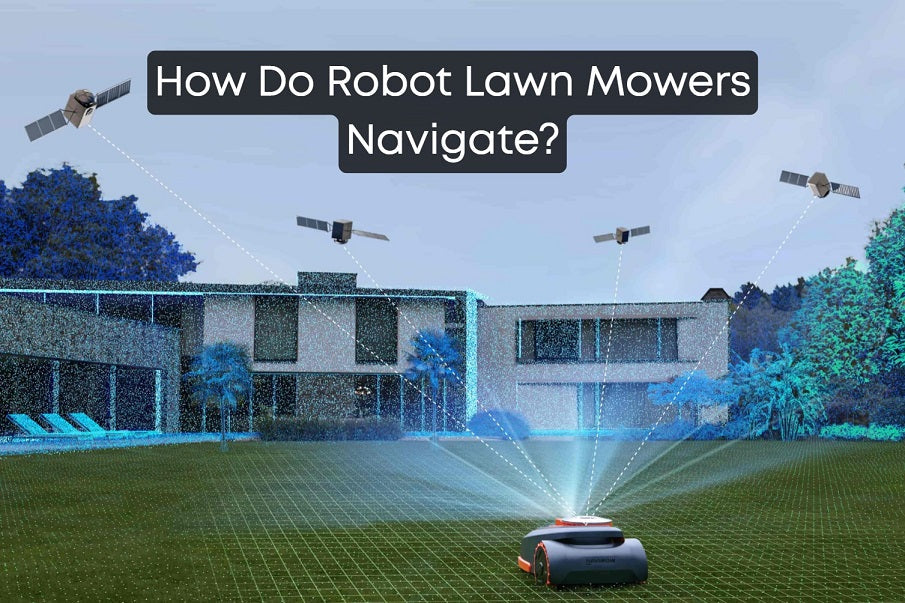
RTK improves navigation precision. It also relies on GPS/GNSS positioning, but it reduces the error down to a few millimetres. It works through a base station that is installed in the lawn. The station knows its exact location, so it can calculate the error in GPS positioning.

The mower constantly communicates with the base station. When it tells the mower there is an error in positioning, it corrects it in real time, enhancing overall accuracy.
Because of RTK, a robot lawn mower can precisely navigate a lawn. It does not have to move in random directions. Instead, it can offer clean stripes. It not only covers every part of the lawn but also reduces the mowing time. The best part is that lawn owners just need to set up the base station; there is no need to bury wires.
Network RTK
We have discussed how RTK helps robot lawn mowers navigate lawns. Just imagine what will happen if the mower loses the satellite signal? It's a common scenario that happens when the mower is under a dense tree, there are buildings around, etc. The mower loses contact with either the base station or the satellite. Thus, it has no clue where to move.
And that's where Network RTK comes into play. It's a network-based GNSS positioning service that offers centimetre-level accuracy. It does not require a base station. Instead, it uses internet connectivity to access GNSS signals. You don't need to install any local antennas or wire.

NRTK does not rely on a single satellite. It works through multiple certified Network RTK providers. That said, it automatically connects to the nearest and strongest signal source. If one source is unavailable, there are other sources to provide the positioning. Therefore, it ensures optimal coverage and consistent accuracy.
This technology makes the mower a plug-and-play device. Users just need to connect the mower to the application, and it's ready to go. It delivers exceptional versatility across diverse environments. It can work over wide areas and in constantly changing conditions. That's why you don't have to worry about geographical constraints and infrastructure limitations.
LiDAR
The above technologies, RTK and NRTK, rely on satellites. But the LiDAR is a built-in navigation system in robot mowers. It is a similar system that you see on self-driving autonomous vehicles. It empowers the mower to navigate a lawn irrespective of the trees, buildings, clouds, etc.
LiDAR stands for Light Detection and Ranging. There is a LiDAR sensor on the mower that emits tens of thousands of laser pulses. These are invisible to the eye and safe. They travel and bounce back when they hit an object. The mower's internal computer calculates the travel time of each pulse. That's how it knows where the obstacle is. It can easily calculate the distance as the speed of light is constant and the time of flight is known.

Once the mower sends tens of thousands of laser pulses in a short time, it generates massive amounts of data. It creates a 3D Point Cloud, which has the information of the obstacles and objects in the lawn. With this, the mower creates a 3D spatial map of the lawn in real-time and navigates precisely.
A LiDAR mower has a complete map of the lawn, so it can plan a route. It does not have to bump into the object. It also takes care of the changes in the lawn. For instance, if there is an object, such as a football, left on the lawn, it will detect it in real-time. It automatically maps the position of the object and adjusts its route.
The best thing about LiDAR mowers is that they can work in complex settings. No matter how many obstacles there are in the lawn, they can navigate the whole area with precision. Whether it's day or night, their accuracy isn't affected.
AI + Vision
LiDAR just knows the distance between the mower and the obstacle. It does not know the colour, texture, or what the object is. For it, an animal and a tree are the same. It cannot distinguish between them.
But Vision and AI give eyes and a brain to a mower. Within this, the mower can see like humans and distinguish between a tree and a person. Not only that, it can recognise animals and species.
For capturing lawn images, multiple cameras are mounted on the mower. It captures images continuously and acts like the eyes. The mower also has a processing unit that processes these images and analyses everything in them with the help of AI. The Neural Processing Unit (NPU) has incredible processing power to process billions and trillions of operations per second.

The mower can also create a 3D visual map through vSLAM (Visual Simultaneous Localisation and Mapping). It tracks the anchor points or stationary objects in the lawn, such as walls, fences, patio, trees, etc. And when it moves, it calculates the shifting of these anchor points and triangulates its own position in the lawn. Through the visual map, you can navigate your lawn with exceptional accuracy.
The major benefit of AI and Vision is intelligent object detection. It can identify objects in real-time, and it's usually trained on different lawn items, suspended objects, everyday obstacles, animals, etc. That's how it safely navigates lawns even if there are animals and kids around.
Visual Inertial Odometry
Visual Inertial Odometry (VIO) is often the hidden technology that assists vision and other technologies.
It works through cameras and sensors, such as high-speed gyroscopes and accelerometers. Suppose the vision system cannot determine the mower's exact position due to a sudden glare from the sun. In this case, the mower estimates its position with changes in acceleration. It knows the last position from the vision tech and calculates the current position by incorporating the movement of the mower.
VIO works along with other navigation technologies. It tracks every movement of the mower to know its location. It uses AI algorithms to get meaningful information from the data collected by the camera and sensors.

The Perfect Fusion in Navimow Robot Lawn Mowers
Robotic lawn mowers cannot perform meticulously using one navigation technology. For instance, if they are using RTK, the satellite signals could get blocked. The vision technology could fail because of glare from the sun and nearby shiny objects. LiDAR technology is unable to understand the difference between a person and a tree.
Thus, the only way is to fuse multiple navigation technologies. That's what makes Navimow robot lawn mowers extra special.
The Navimow i2 AWD (NRTK + Vision)
The Navimow i2 AWD series is an affordable mower packed with incredible features. It's suitable for lawns up to 800 m². It navigates small to medium lawns with the NRTK and Vision technology. The best part is that it automatically maps your whole lawn and covers every corner.
The NRTK ensures centimetre-level accuracy. With triple-frequency, it delivers a 30% boost in accuracy and maintains stable signals even in tight or obstructed areas. The Vision tech assists NRTK and detects over 150+ obstacles. It uses a 140° RGB Camera to capture images around the lawn. Because of these technologies, the mower can navigate flawlessly under tall trees, narrow pathways, and hidden corners.

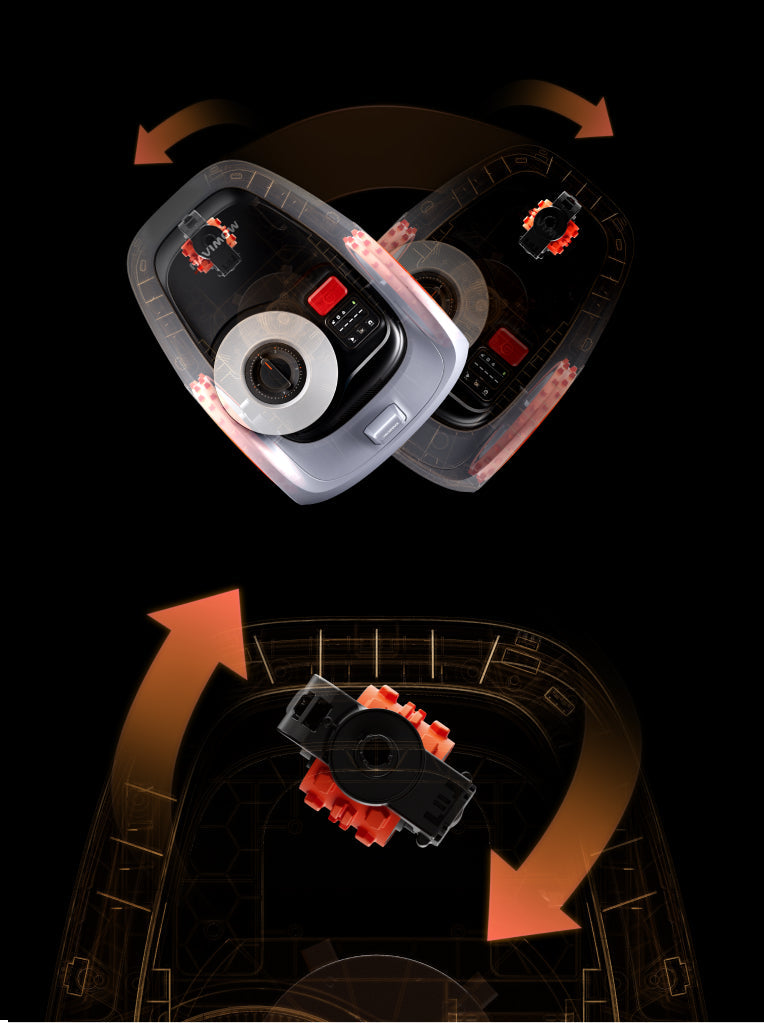
Apart from that, the mower is equipped with an advanced AWD (All Wheel Drive) system. It offers exceptional performance across all terrains. It also features the Xero-Turn™, which allows it to take 180⁰ turns instantly without harming the lawn. It's a quiet, smart, and reliable mower that saves you time and money.
The Navimow i2 LiDAR (LiDAR + Vision)
The Navimow i2 LiDAR is a compact mower series with LiDAR navigation. It is suitable for lawns up to 2000 m². It's a Drop and Mow mower, which means you just need to drop it on the lawn, and it's ready to mow. With LiDAR, it instantly scans and maps your whole lawn.
Despite being an affordable mower, it has a high-res solid-state LiDAR. It scans 200,000 points per second at 4X higher resolution than other mowers. It offers a 70m long range and a 50 ms scan interval, so even if there are recent changes in the lawn, the mower adapts to them immediately. GeoSketch™ shows real-scene maps in the app that users can edit and fine-tune for impeccable results.
It navigates in narrow passages, under dense trees, and in difficult areas. It offers equivalent performance during the day and night. The solid-state LiDAR is meant for optimal reliability. With no fragile parts, a scratch-resistant design, and 50G shock resistance, it lasts a long time.

The mower detects 200+ obstacles with 1cm precision. It can detect suspended objects like chairs, hammocks, tables, and trampolines. It also recognises 20+ animal types and ensures safe mowing. You can use it in lawns with complex settings and slopes up to 45% (24⁰). It handles tough grass with 100W peak power and mows edges seamlessly.

The Navimow H2 (LiDAR + NRTK + Vision)
The Navimow H2 series is known for its AI Triple Fusion System. It combines high-res solid-state LiDAR, Network RTK, and Vision to guarantee absolute precision and reliability.
It is equipped with autonomous-drive LiDAR tech that scans 200,000 points per second. It creates a dense 3D point cloud with no blind spots. It covers every contour, edge, and object in the lawn.

The mower sees the lawn as your eyes see. With LiDAR and vision, it converts your lawn into a real and interactive map that you can visualise and edit through your phone and command the mower. It gives you total control for unparalleled accuracy.
The notable feature of the mower is that it seamlessly switches between positioning modes within 20ms. If one mode fails, the mower shifts to another. That's how the mower works in every situation and scene. Whether it's an open terrain, a narrow path, or total darkness, there is no compromise on the performance.
With the Terrain Adapt, the mower analyses your lawn. It divides the space into optimised zones and plans the ideal route, even on slopes. It navigates with 1cm accuracy and detects 200+ obstacles. You can enjoy artisan-level mowing every day without any effort.

The Navimow X4 (NRTK + 360⁰ VSLAM + VIO)
The Navimow X4 series is the master of every terrain and scene. It performs where other mowers fail. It's capable of navigating large lawns up to 5000 m² with exceptional precision.
With Tri-frequency NRTK, 360⁰ VSLAM, and Visual Inertial Odometry (VIO), it knows its exact position in the lawn. It automatically recognises boundaries and creates freehand virtual maps seamlessly. Its triple panoramic cameras and ToF sensors generate top-down, real-scene maps. You can see them on the app and edit directly on your phone.

Its AI-Powered 360° VisionFence™ and Animal Protection take obstacle detection and safe navigation to the next level. It can detect obstacles within a 5-meter range, maintain a 1-meter distance, and reroute within 0.1 seconds. It recognises animals, everyday objects, lawn items, and almost everything. The best part is that it does not affect its mowing performance.
The Navimow X4 series is extremely powerful. It dominates all terrains with All-Wheel Drive (AWD), dual suspensions, patented Traction Control System (TCS), and a 5:5 balanced centre of gravity. It can even mow on steep slopes up to 84% (40⁰). Not only that, but it can cut long, thick, and dense grass with powerful dual motors. It also features Xero-Turn™, which allows it to turn like a zero-turn mower without harming the lawn.
The mower is meant for exceptional efficiency, precise navigation, and advanced obstacle detection. It can handle up to 120 zones, including non-mowing areas, which is ideal for massive lawns.

Final Words
Traditional robot lawn mowers navigate through perimeter wires, but the latest ones are completely wireless. They are equipped with advanced navigation technologies, such as Network RTK, LiDAR, and AI + Vision. It allows them to navigate small to massive lawns with centimetre-level accuracy. You just need to drop them on the lawn; they automatically mow the area and start mowing. Most importantly, they mow safely around kids and animals, and cover every corner without human assistance. And this is what true automated lawn mowing is.